
Field Access Vehicles
Remote landscapes do not come with standardized roads. NBM plans to match the field vehicle to the route, the participants and the conditions.
Different routes require different field assets.
Some field locations can be reached on maintained forest roads. Others may require narrow, primitive roads where vehicle width, turning radius, ground clearance and maneuverability become critical.
NBM's approach is to select transportation for the actual field assignment rather than force every program into a single type of vehicle. The objective is practical, professionally coordinated access that gets participants to the places where observation, education and productive conversation can occur.
Access is the capability. Understanding, education and productive conversation are the purpose.
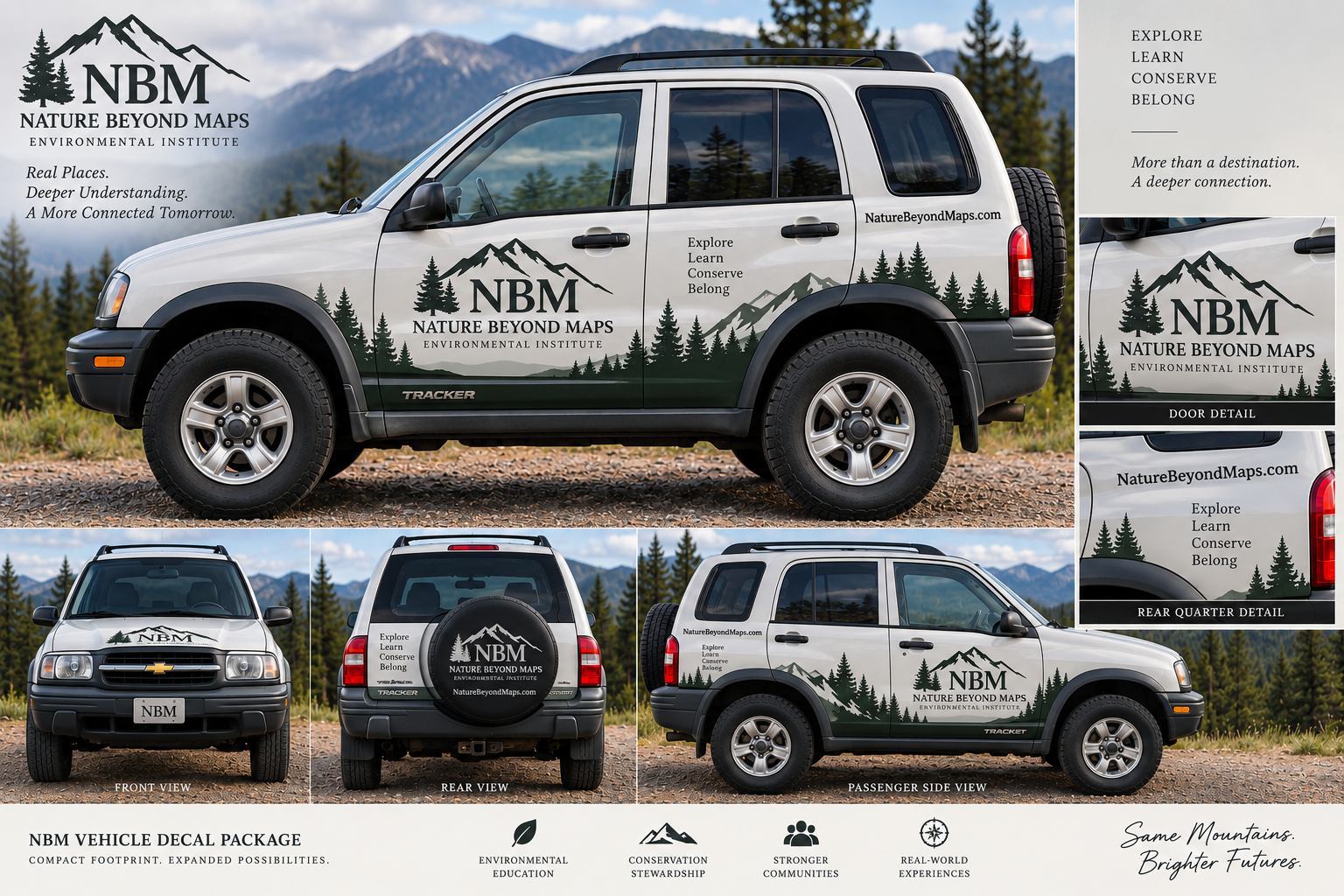
Conceptual NBM compact field vehicle. This illustration represents the type of compact field-access configuration NBM is evaluating. Final vehicle models, equipment and graphics may vary.
A layered approach to remote access.
Compact Enclosed 4WD
NBM is evaluating compact, street-legal four-wheel-drive vehicles as primary Phase I field transportation. Vehicles approximately 70 inches wide or less can provide weather protection, passenger capacity and direct road-to-field travel while remaining substantially narrower and more maneuverable than many conventional SUVs and trucks.
Specialized Utility Field Vehicles
Where routes become narrower, rougher or otherwise unsuitable for conventional road vehicles, multi-passenger utility SxS field vehicles may extend NBM's access capability. Their smaller footprint and terrain capability can make them appropriate professional field assets for specific assignments.
Support Vehicles
Larger 4WD support vehicles can carry the infrastructure that makes a field day work: communications, water, emergency and safety equipment, shelters, Field Table equipment, food-service systems and other program supplies.
Built around the realities of backcountry roads.
In the Inland Northwest, some useful observation sites are reached by roads that were never designed for today's full-size trucks and SUVs. Brush, trees, tight turns, limited shoulders and narrow roadbeds can make overall vehicle size an operational constraint.
That is why NBM is particularly interested in compact enclosed 4WD field vehicles with a small footprint, useful ground clearance, appropriate four-wheel-drive capability and enough passenger capacity to move small groups efficiently.
For Phase I, this approach may also reduce dependence on trailers and dedicated tow vehicles because road-legal compact field vehicles can travel directly between the operations base, staging area and appropriate field routes.
Field vehicle selection considers:
Route width and turning room • terrain and surface conditions • weather exposure • passenger needs • ground clearance • communications and emergency planning • equipment load • turnaround and recovery options
Utility SxS vehicles are field tools—not the program.
NBM may use specialized multi-passenger utility SxS vehicles when their size and terrain capability make them the appropriate platform for a route. They are selected as professional field-access assets supporting environmental education, observation, conservation, stewardship and land-management programs—not as recreational riding vehicles.
The same principle applies across the fleet: the vehicle is there to enable safe, practical access to the landscape. What happens after participants arrive—the observation, learning, discussion and collaboration—is the reason for going.